
 Last Friday, I gave a talk at brightonSEO October 2020, the first time it’s been hosted online (as a result of lockdown). It was my third time speaking at bSEO (here are the links for the first two).
My talk – titled “Going Solo – The Survival Guide for Freelance SEOs (Present & Future)” – gave advice to aspiring, new, and established freelancers, which – during these difficult times – I’m hoping would’ve been useful to a lot of people.
If you missed it live, you’ll need a ticket in order to watch the talk back. However, I can share with you the slides and the talk’s transcript, which I’ll share below…
…But first:
Other freelancers give their tips

To complement the talk, I asked six other SEO freelancers for their tips. The original plan was to include their tips within the presentation, but with a strict 20-minute timeframe, it just wasn’t doable. So what I did instead is published their tips in full over on the Anti-Sell blog.
Slides
So here are the slides:
Talk transcript
And here is the transcript (which I got by using Otter.ai):
Slide 1 – Intro

Hello everyone. My name is Steve Morgan, I am a freelance SEO, and I’m going to be talking to you today about freelancing for SEOs. 20 minutes isn’t a lot of time to talk about this kind of thing. So I’m going to jump straight into it.
Slide 2 – About Me
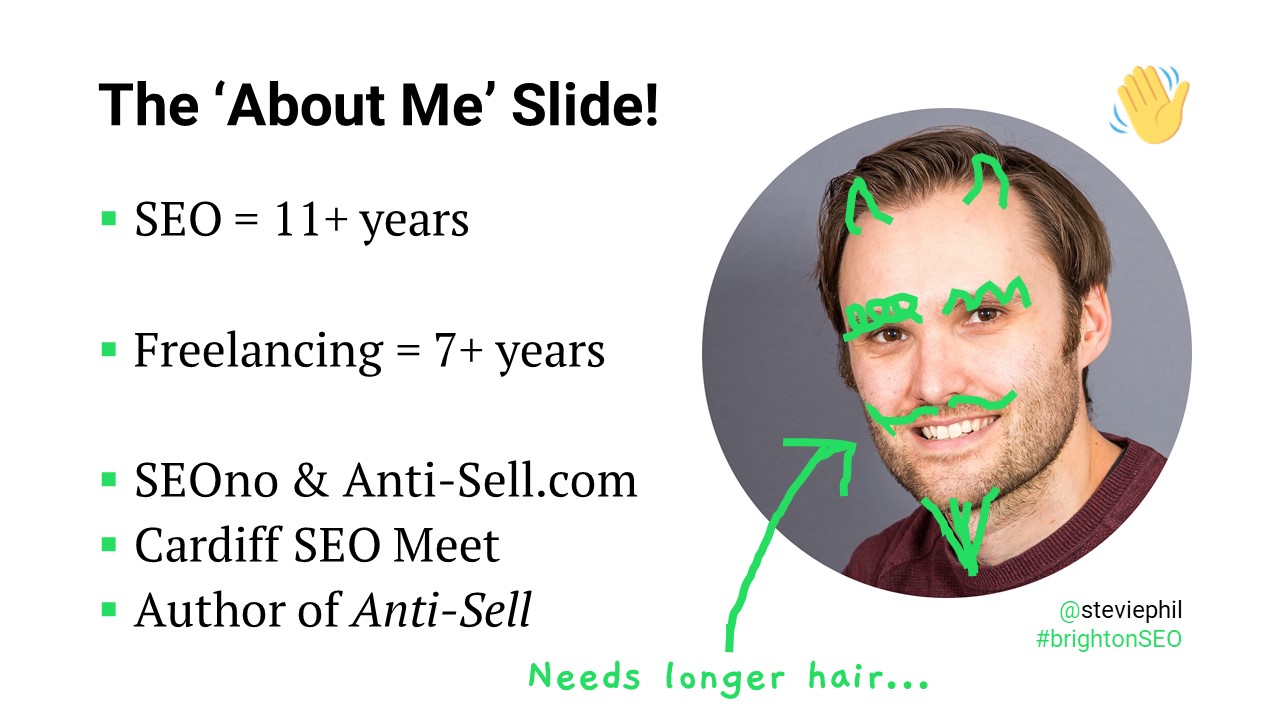
So firstly, about me. Not because of any sort of vanity thing, or like, “oh, look how awesome I am.” But more so that you know I’m actually qualified to talk about this kind of stuff. So I’ve been working full-time in the SEO industry for 11 years, since 2009. And for the last seven-ish years (so May 2013 I think it was) I’ve been freelancing. I blog with an SEO blog called SEOno, but more frequently these days a newly-launched blog called Anti-Sell. I run a meetup. And last year I wrote and self-published a book giving sales and networking advice to freelancers – or anyone in particular, basically – who doesn’t like sales. And for those of you who already know me, I grew lockdown hair, which you can probably see if I do that [takes headphones off]. So yeah, I need to update my profile pic for sure to something that matches my current look.
Slide 3 – Pros of Freelancing
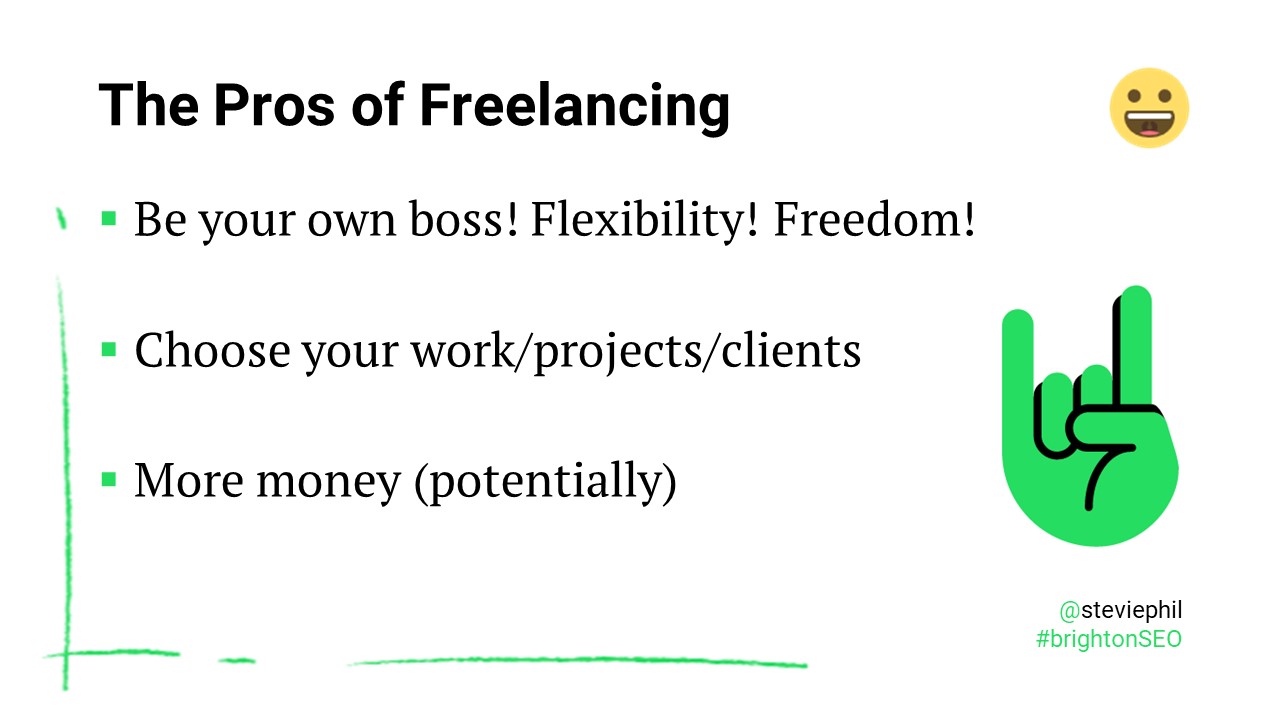
So the good sides of freelancing. To be honest, if you’ve already looked into freelancing, you probably know all this stuff. But it’s good to reiterate. The obvious one: you’re your own boss. You can be as flexible as you want. You have the freedom to do what you want, how you want to, where, when – it’s all up to you. And you can choose your work, your projects and your clients. I don’t know if this has happened to other people, but you might be working in an agency and you’re given the type of work that isn’t really your skillset – or you might just have a client who’s a complete jerk. You get to choose who you want to work with, which is amazing. And potentially (in brackets) more money – I say potentially because I think once you get going you probably will earn more money as a freelancer than potentially agency or in-house, but it can take some time. It took me a good couple of years to match my old agency salary. But now I earn more than that salary working four days a week, so yeah, it can be good.
Slide 4 – Cons of Freelancing
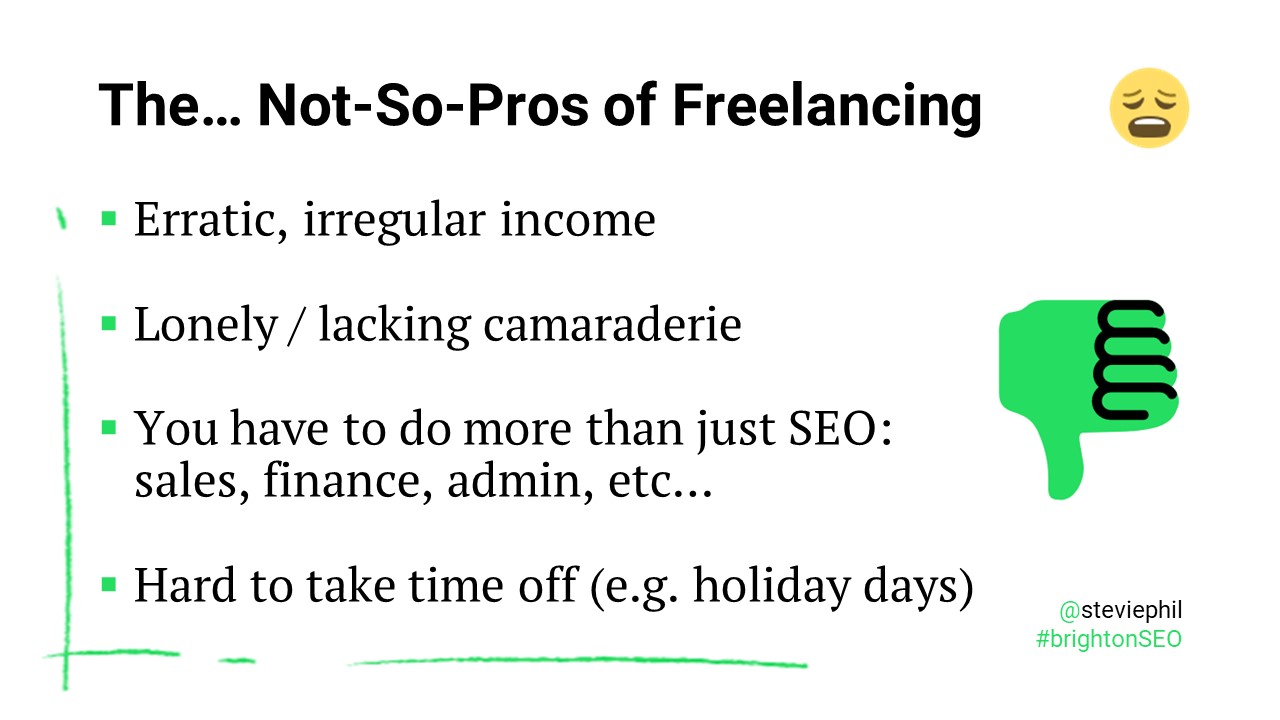
The cons of freelancing – the not-so-good side things – is your income becomes a bit all over the shop. You’re not necessarily gonna get a guaranteed income or salary like you used to working employed. You might have one month you invoice tons, you might have another month where you invoice very little. Side note: it can make mortgage applications really difficult as well. And it can be lonely and it can lack camaraderie. I love freelancing and I prefer it to agency life, but I do miss chatting to a friend/colleague about a project or picking people’s brains with the people just sat opposite you. You don’t really have that anymore – it’s you on your own. There’s obviously ways around it, such as the people you kind of hang out with and chat to, which are I’ll cover more about later.
You have to do more than just SEO. So if you’re working in an agency and you’re in charge of link building, you just do link building. But if you’re running your own link building freelancing business, then you don’t just do link building for clients. You’ve got to find those clients in the first place. You’ve got to take care of your income and your expenses, you got to do admin, and other stuff that comes with running a business. So it’s not all just you working on your specialism necessarily.
And it can be hard to take time off. It’s that old cliché of when you work for yourself, you just work really hard and you work seven days a week. It’s not necessarily so much that, but it’s just very easy to forget about taking like proper holiday days. For example, when you’re employed you have like I think it’s at least like 20 and you’re probably reminded by employer: “you should use these up.” When you’re working, you can just work and work and work and be like: “oh, I haven’t taken a day off in ages.” So there’s that side of it as well.
Slides 5 & 6 – Before Going Freelance
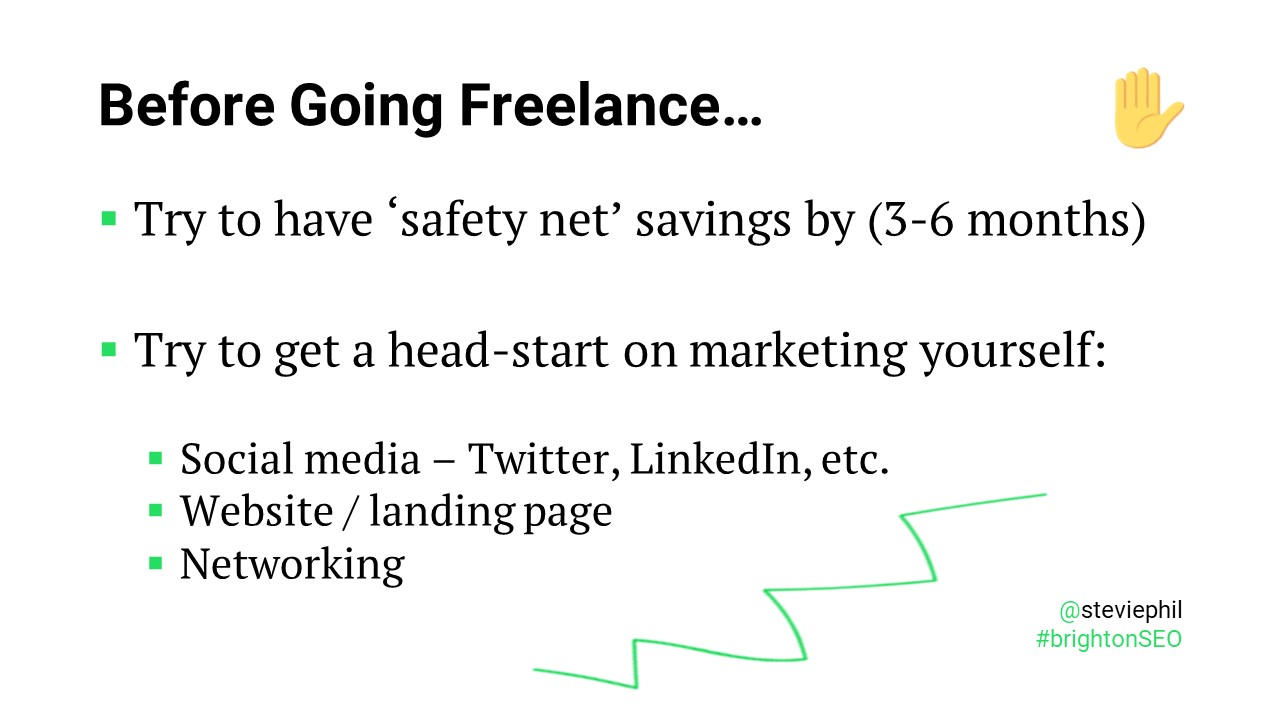 Before you go freelance – and I appreciate not everyone will have this luxury, if you’ve for example been made redundant or furloughed because of COVID – but if you have got the opportunity to save some money by – probably 3-6 months’ worth – is a really good idea. Just because the first few months, you might have costs in terms of getting stuff made up, such as a website, business cards, hiring an accountant, stuff like that. And then maybe not necessarily many clients, so you might be spending more than you’re earning – but hopefully, obviously, a few months into it it’ll break even and you’ll be earning a lot more than you’re spending.
Try to get a head-start on marketing yourself as well. So if you have the opportunity to post on Twitter, LinkedIn, etc. saying you’re going to be going freelance soon, that could be a good way to sort of have conversations early with potential clients or referral partners. And have a website or landing page about you and your services. Even if you’re reluctant to sort of publish it before you go freelance, you could have it ready, drafted, hit the publish button on Day 1.
And networking as well. If you can get a head-start with networking. The only thing I’ll say is obviously be careful – if you’re say for example leaving an agency role to go freelance, it might be that the agency you work for will be really supportive and they’re really great people, or it might be that they’re not so much. So just obviously be careful about sort of who knows and how open and public you are about your plans necessarily, especially if you’re worried that it might rock a few boats.
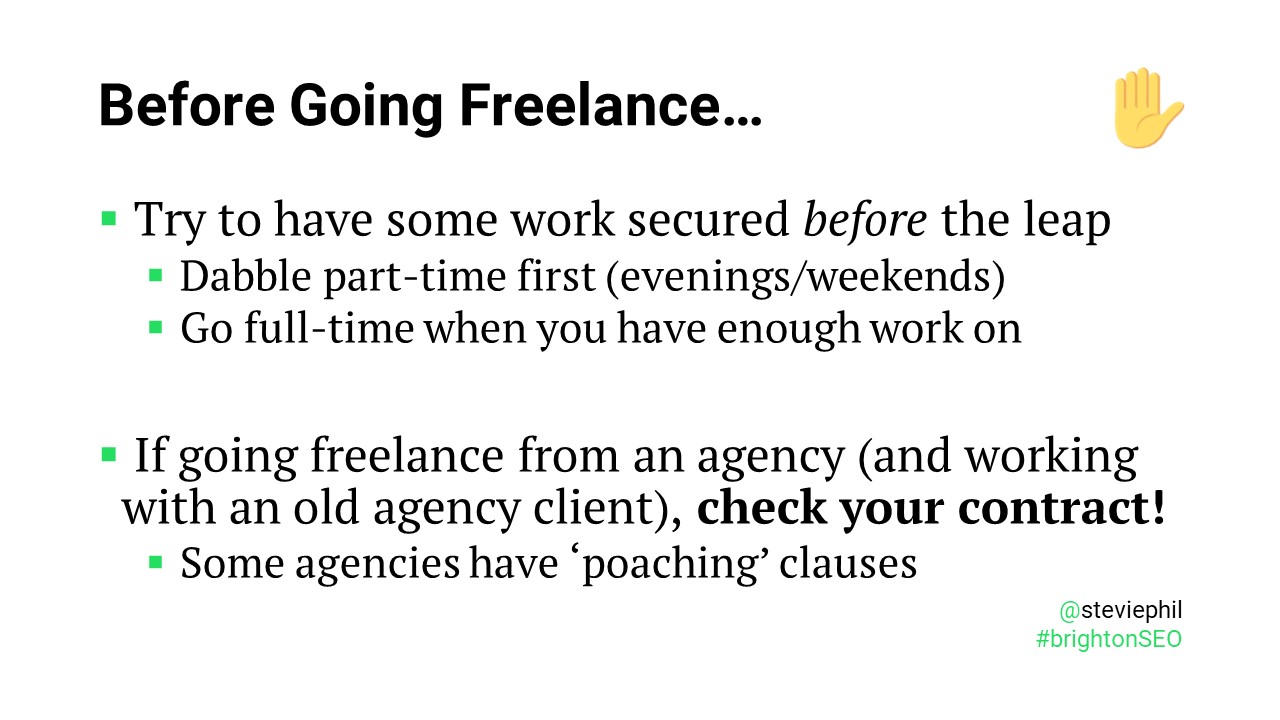
Before going freelance continued… If you can, try and have some work secured before you take the leap into full-time. For example, dabble in part-time first, evenings and weekends. This is also a good test to see whether you like freelance – you might you might be thinking “I’ll try freelance out” and then you realise you don’t actually like it, so you’ve not really fully committed, you’re kind of ‘testing the waters’ if you will. And then also just kind of get a few clients on-board, make sure it works. And then once you get to a point where you think “right, if I leave my full-time job now to go freelance, I could probably make this work.” A mistake I made was I had about a dozen prospects and leads, but that’s all they were: they were prospects and leads. And then when I actually went freelance, I quit a full-time job to go full-time freelance, only one of those projects came off. And I was like “oh my god!” – so don’t make the mistake I made if you can help it. And again, as I said before, appreciate if you’ve been made redundant, you might not have that luxury anyway.
And if you’re going freelance from an agency, and you’re potentially looking at old agency clients, check your contract. A lot of agencies have I call it a poaching clause, it’ll say something like you’re not allowed to work with any of the agency’s clients for 6 or 12 months after leaving. So you wouldn’t want to say, leave your agency job, with a client who’s like: “oh, if you go freelance, I will work with you directly instead of through the agency.” And then your agency says, “yeah, legally, you’re not allowed to do that.” Because that could be a bad first step into freelancing.
Slide 7 – Going Niche
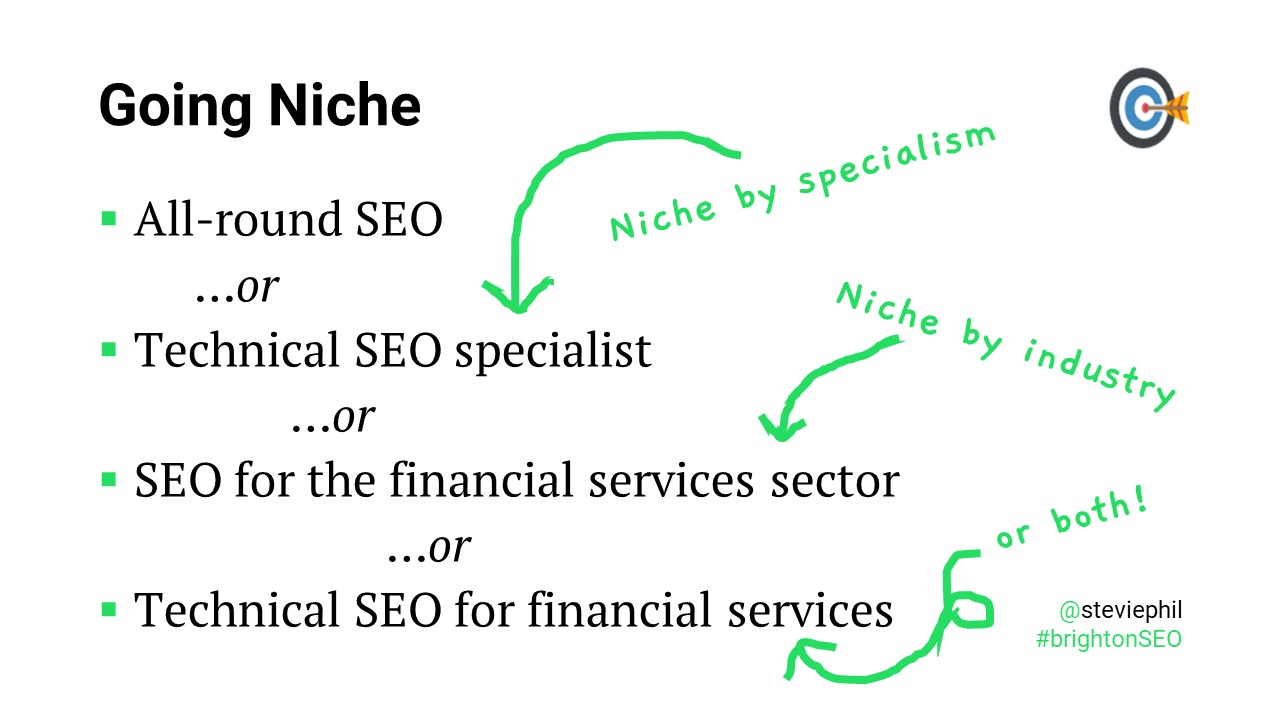
Going niche. So you’ve got ways you can go about what services you offer and how you sort of position yourself as a freelancer. I’ll give a few examples. So you could be an all-round SEO. And to be honest, I’m an all-round SEO, working with mostly small businesses but a few bigger businesses. So I’ll help them with everything: keyword research, technical SEO, link building, Google Maps if applicable – all that jazz.
You may however want to just specialise in one area of SEO – and SEO itself is a specialism, but you can specialise within it. You may be just like thinking, “you know, if I’m going to be a freelancer, I’m just going to do technical SEO.” So that’s essentially niching by specialism. Or you may decide to do SEO just for certain sectors or industries, for example, you just do SEO for the financial services sector. This could be a good shout if most agency clients you worked with were say financial services sector, or you were in-house at a financial services sector company – but obviously only if you, you know, actually enjoyed the work and would want to do it as a freelancer. Because that’s important as well: you’ve got to remember and realise it’s got to be stuff you want to do. So that’s niching by industry.
Of course there’s nothing stopping you from doing both. So you could just do technical SEO for the finance services sector, which narrows you down, which can be a blessing and a curse. So the more niche you go, then the smaller the pool, if you will. So you’ve got fewer potential clients. But if there’s somebody who needs technical SEO, and they’re a financial services company, and they hear about a specialist technical SEO for a financial services company, they’re going to more likely hire you over the all-round SEO who works with all industries, for example. You become more appealing, you’re more specialised, you’re savvier with the kind of work that you do for those kinds of clients and that kind of work: technical SEO. Another thing as well is say if you are working with referral partners to try and get leads, if you team up with say a freelance link builder, a freelance keyword research person, a freelance Local SEO, you could potentially all pass each other projects. So if you get a Local SEO lead, you say thanks, I don’t do that, but I’ll pass it on to my friend and vice versa – people will know that you’re the go-to technical SEO referrer.
Slides 8 & 9 – Sales & Networking
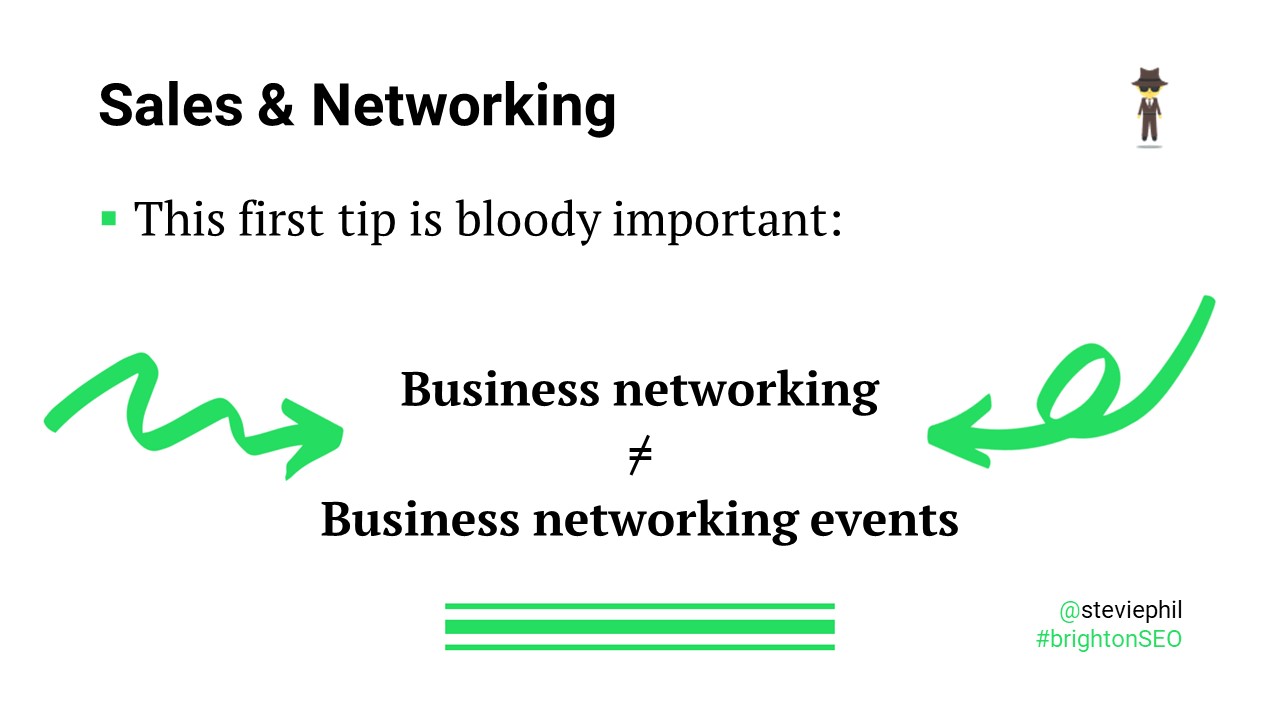
Sales and networking. Right, this first tip is really, really important. Business networking does not necessarily mean business networking events. I was very naive when I started networking and thought that networking only took place in business networking events. Networking can take place everywhere and anywhere. So long as you’re having a conversation with somebody, and there’s a chance that they may pass you work in the future. They are a, you know, potential referral. So, going beyond that, you don’t have to just go to like business networking events where people put on a suit and give out business cards, because people don’t, you know, not everyone relates that.
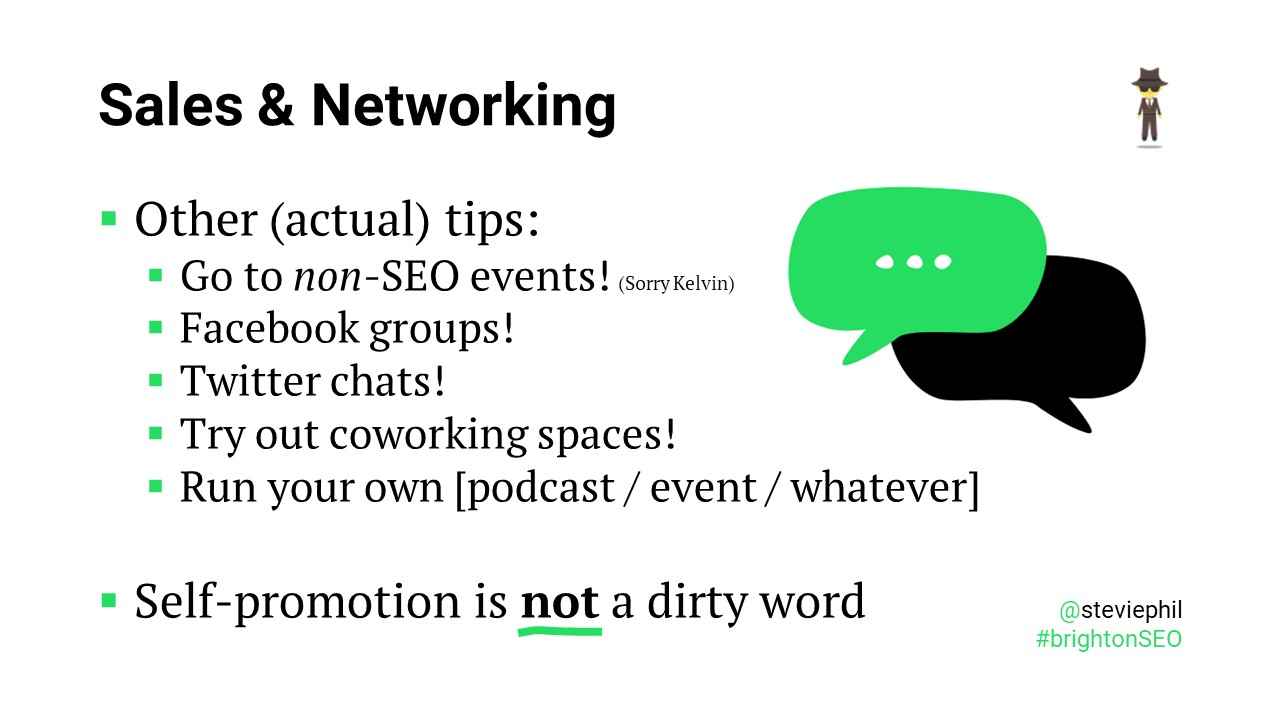
A few tips I have for you… Go to non-SEO events as well as SEO events. So networking at somewhere like brightonSEO is great. But if you are networking at SEO events, you’re potentially networking with your peers and your competitors. If you network at, say, a web developer meetup or a social media marketing community, then you may be the only SEO who hangs around in those spaces, they’ll probably have questions for you. And then you sort of get to know, be known and be trusted by that group of people. I went to a web developer conference once and I was the only SEO in the room and it was gold. Don’t get me wrong, I didn’t go just a sort of network and sell myself – I learned a lot from the day as well – but the networking side of it was beautiful.
Facebook groups. So one that’s works really well for me is a local entrepreneur, small business group. I’ve gotten sort of well-known in there just by sharing advice and helping people – and it’s not even necessarily SEO help. It can be other advice as well. But if people need an SEO person in there, they often refer me, which is lovely.
Twitter chats: a bit like the Q&A style ones, like the common ones in SEO are like #SEOChat, #SEMrushchat, things like that. But you could do them using that tip from before in places like… one that used to work pretty well for me was #BlogHour. So I don’t think it’s going anymore, but it was like bloggers discussing a different topic every week, and I used to be one of the only SEOs in there. So I used to sort of, you know, answer questions about that and help out on that front.
Try out coworking spaces. Now I appreciate COVID has done damage to this industry. I usually work out of a coworking space, and it breaks my heart what COVID has done there. A lot of them are reopening now with really strict safe guidance and guidelines, to make sure that it’s as safe as possible. Coworking is great, because you might be the only SEO at a coworking space, you get all the referrals there. Also the nature of people who will set up in a coworking space are small businesses, startups… they might think “right, we’ve just moved into coworking space we need a new website, we need SEO.” Boom, there you go.
And a really good way to get known is if you run your own something – it could be your own podcast, it could be your own event, it could be your own webinar, it can be your own… whatever it is. It’s good way to get yourself out there and to potentially network with… I mean if it’s a podcast, every guest you invite on is potentially someone you can network with – someone who may not have known you previously, who now knows who you are, but you invited them onto your podcast.
And it’s really important to know that self-promotion is not a dirty word. I think a lot of people think it’s icky and acky. So long as you’re not overdoing it and overly promotional and overly salesy and being careful what you do, you shouldn’t like hide yourself away – you should, you know, market yourself if you can.
I think I’m already behind on time looking at my stopwatch, so I’m going to whiz through these.
Slides 10, 11 & 12 – Business (Finance, Legal & Admin)
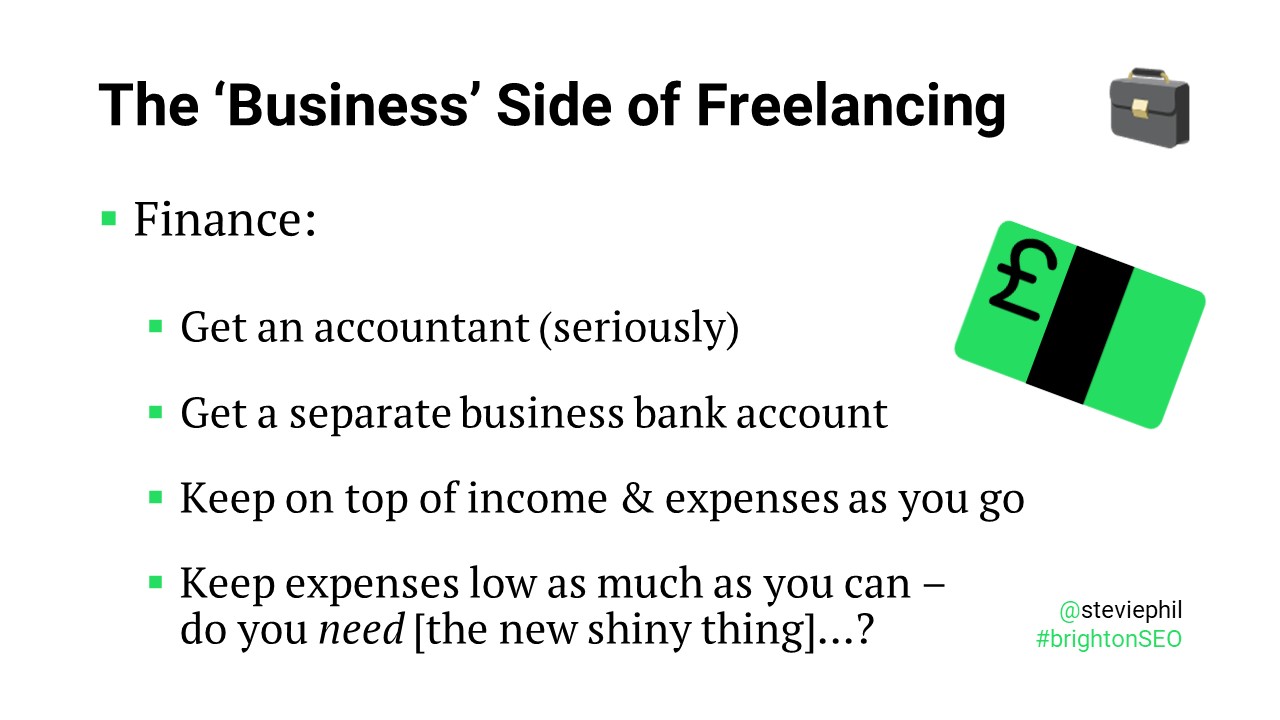
Let’s talk quickly about the business side of freelancing. Get an accountant: you may be able to get someone to help you with your tax return for as little as say £100 a year; saves you the time from figuring out how to work with HMRC’s website and process. You can just pay someone to do it and make the money back doing additional work for somebody.
Get a separate business bank account. So I don’t think this is a requirement if you’re a sole trader, but it’s worth doing anyway just so you can keep your personal and your business finances separate. Makes it easier for when you’re doing tax returns as well.
Keep on top of income and expenses as you go. What I mean here is just have a couple of spreadsheets or if you’re using some software where you can log it… Just do it as-and-when a new expense comes in when, you know, you send out an invoice – rather than at the end of the tax year, having to go through 12 months of stuff and be like “right, where did I keep all my paper receipts; right, let’s go dig through all my old emails.” It just makes it a lot easier if you do it as-and-when you’re kind of going along.
And keep expenses as low as you can. The difficult thing about being a freelancer is you may want lots of different software. But do you need all that software? If you work in an agency you probably got like all the software, but obviously as a person on your own, you may not be able to afford everything so do you need a new shiny thing can you make do without it?
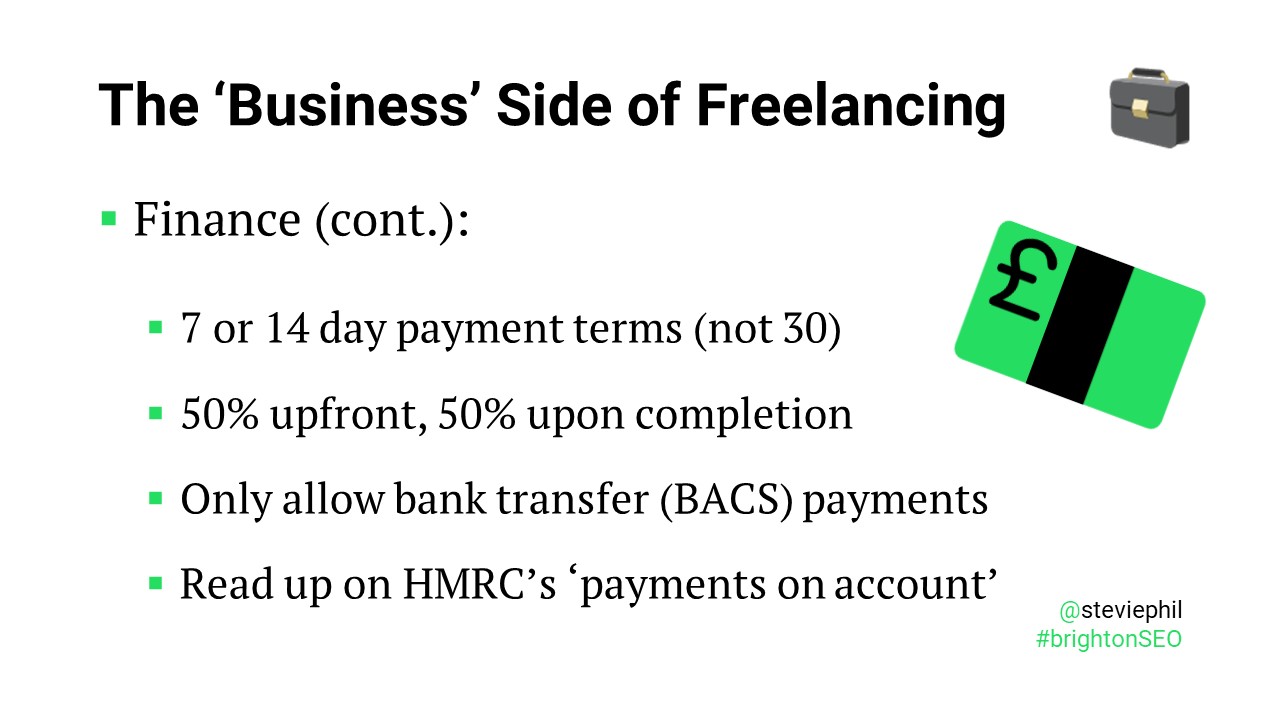
More finance stuff quickly… The traditional payment terms – when you say you’ve got to pay my invoice by how many days – is 30. 7 or 14 days is fine. What happens is if you do 30 is after 30 days you chase the person and they go “I’m really sorry,” and then they take another 30 days to pay your pay, so you’re paid 60 days later. If it’s 7 or 14 days, you’re probably going to get your money quicker.
If you’re doing one-off projects, ask for 50% upfront, 50% upon completion. That way you know if they’re reliable and that they actually pay the first invoice. And also sometimes you have an issue where say if the completion part is when a website is launched, and the website gets delayed and delayed and delayed, that means your money… it maybe later until you get paid – at least you’ve got some of the money in advance.
Only allow bank transfer payments… I say “only allow” – what I mean here is I first said to people you can pay me by bank transfer or cheque, and I had that one client who paid me by cheque every month and it was like so annoying because it was literally the only time where I had to pop out my way to go to a bank – and then as soon as I said to him “oh, can you pay by bank transfer?” he said “yeah, that’s fine.” And also be careful with PayPal because PayPal I understand is really easy for the buyer to say actually I want a refund and for PayPal to side with them. If anyone says they only want to pay you by PayPal and not by bank transfer or some other means then that’s usually a red flag.
And read up in advance about payments on account. HMRC has this thing where… I can’t remember the criteria (speak to an accountant), but about your second year if you hit certain criteria, you have to sort of pay 150% of your tax in advance – you pay for the coming year and I think a bit of the following year as well. Everyone I know gets caught out and they’re like “oh my god, I didn’t realise I’d have to pay that much.” So it’s just something to look into and make sure you’re saving enough money by for when it hits.
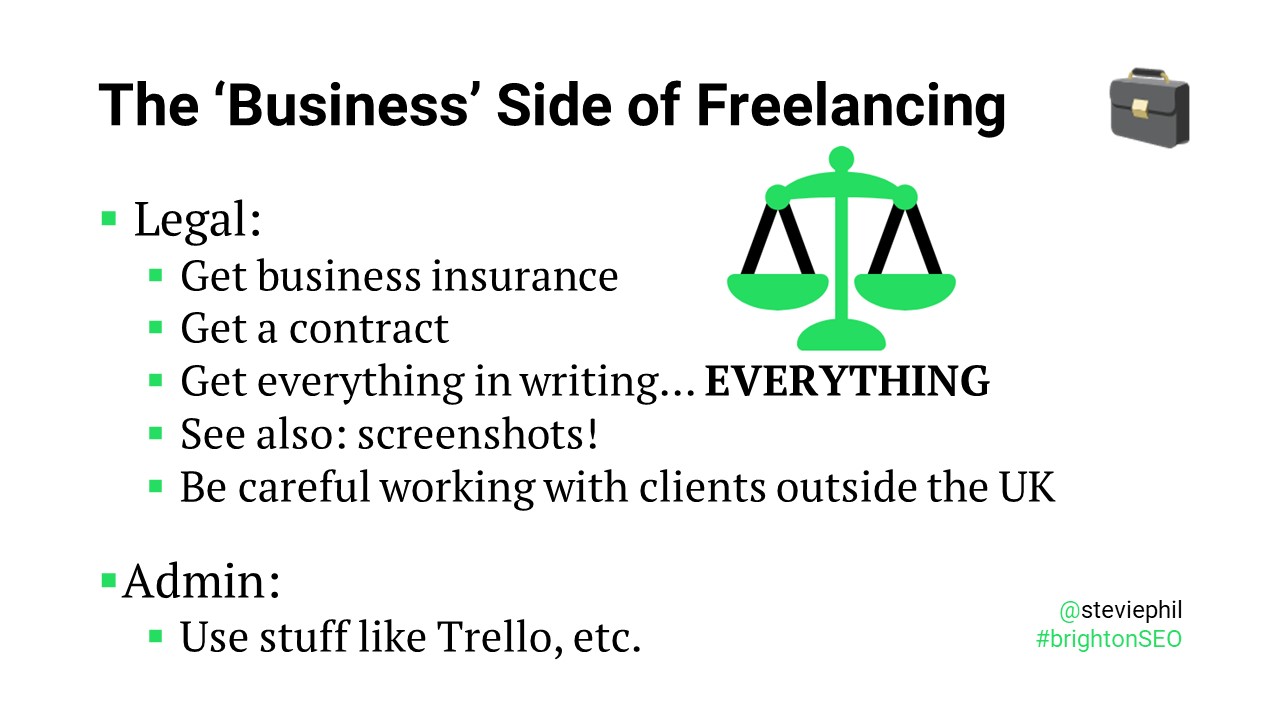
Legal. Let’s get through this really quickly.
Business insurance: professional indemnity, public liability. It’s worth the peace of mind for, you know, £100/£200 a year.
Get a contract. Just for peace of mind, clients will take you more seriously. To just make sure that you have everything in place that protects you.
Get everything you can in writing. Not just a contract, but everything in emails. If you’re somebody who works with clients who like to talk over the phone, send an email afterwards and say “here’s a summary of everything we discussed.” What you don’t want is some sort of dispute happens or some sort of disagreement, and then you realise every conversation you ever had with them was on a phonecall, so there’s no proof of it ever existing, and then you’ve got to try and remember “what did I promise? What was said?” Blah, blah, blah.
Screenshots as well. If it’s not something that’s writing. So a good example is years ago, I think Google Search Console didn’t used to send you emails about things. And I wanted to put screenshots of, you know, when you remove a manual penalty, and they used to send you a message within Google Search Console, saying “congratulations” – so I took a screenshot of that. And that came in handy once when I had a dispute.
And be careful working with clients outside the UK. My understanding here is if you work with say somebody in the UK, you can take them through the small claims court process if they don’t pay. If they’re outside of the UK, it suddenly gets a lot harder. So if you’re owed money, it will be harder to get that money back.
And then admin. I mean, I wanted to concentrate more on the finance and legal stuff, but in terms of the admin, use stuff like Trello or whatever project management tool you like to use, to keep on top of things.
I don’t have much time. I think I got about three minutes left.
Slide 13 – Growing Into an Agency
So the good thing about freelancing is it’s a stepping stone into growing into an agency. You don’t have to go into an agency if you don’t want to. I know it’s kind of standard in society that you start getting a lot of work in, you need to hire staff, you need to grow a business. If you want to be a freelancer, stay as a freelancer. You can always put your prices up and grow your business that way. But if your grand ambition is to grow an agency, start off freelance, see how it goes, and then you can comfortably just hire a member of staff here, hire a member of staff there, and go into it that way.
I’ve gone the wrong way. There we go.
Slide 14 – Facebook Groups for Freelancers
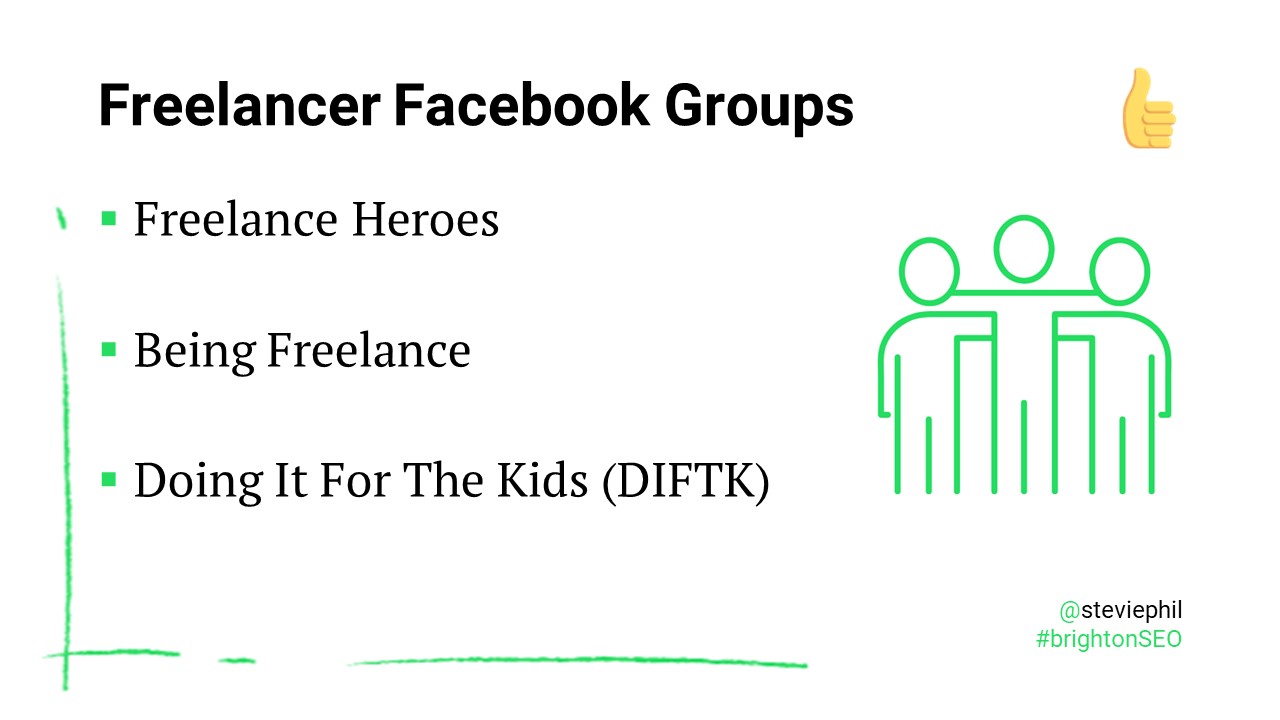
A few recommendations of freelance Facebook groups.
Freelance Heroes, about 10,000 people, they only let in freelancers in the UK and they kick out anyone who self-promotes, that kind of thing.
Being Freelance is on a smaller scale and the guy who runs it – Steve Folland – is lovely and really funny.
Doing It For The Kids is aimed at freelancers who are also parents.
Slide 15 – Podcasts for Freelancers
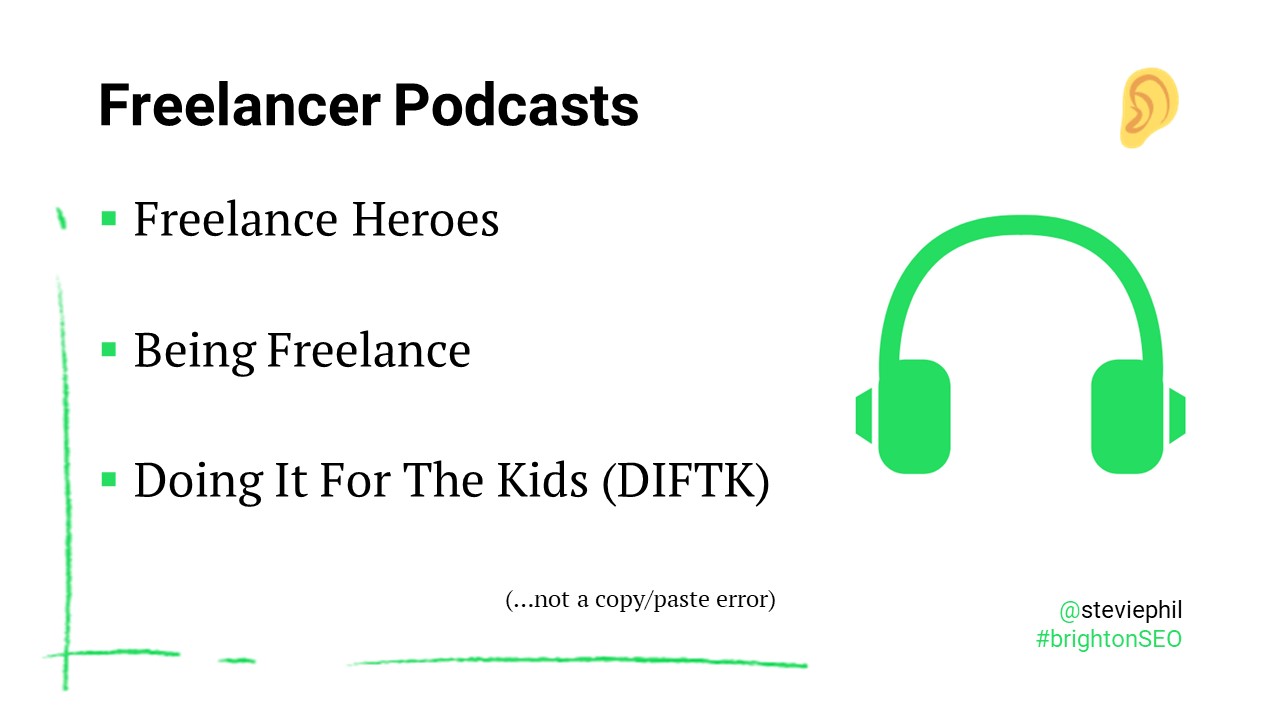
And that’s not a copy paste error. All three of those communities also run podcasts. So Freelance Heroes has just launched theirs. Being Freelance… Steve has interviewed over 200 freelancers over the years. Really interesting stories and learning from those people. And Doing It For The Kids is Steve of Being Freelance fame and Frankie, and they are absolutely hilarious – and every week or however often it is, they talk about people’s issues and difficulties freelancing with children.
Slide 16 – Books for Freelancers
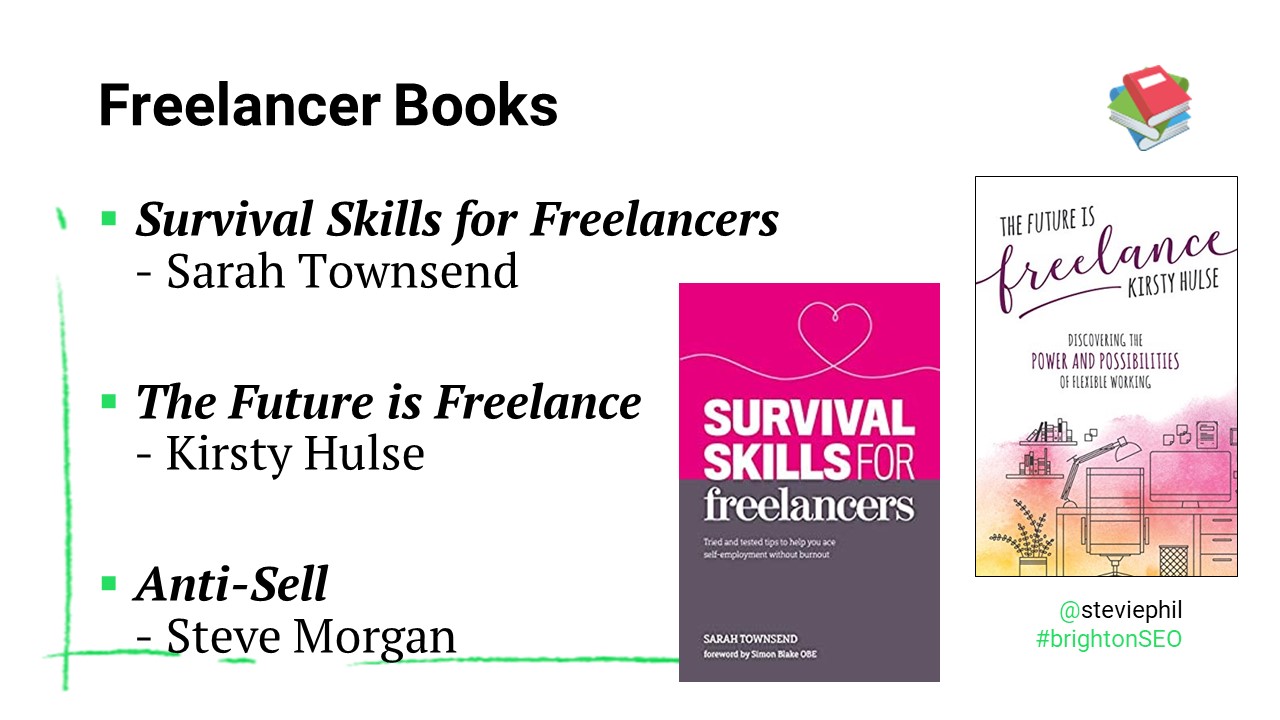
A few book recommendations…
Survival Skills for Freelancers came out recently. I’ve personally not read the finished version – I read an early draft – and it was brilliant.
Kirsty Hulse: a lot of people will recognise the name, she used to work in SEO, she’s now more of a sort of training consultant and confidence coach. She wrote a book about freelancing.
And I wrote a book, which I’ll talk about more in the final slide.
Slide 17 – Contributions
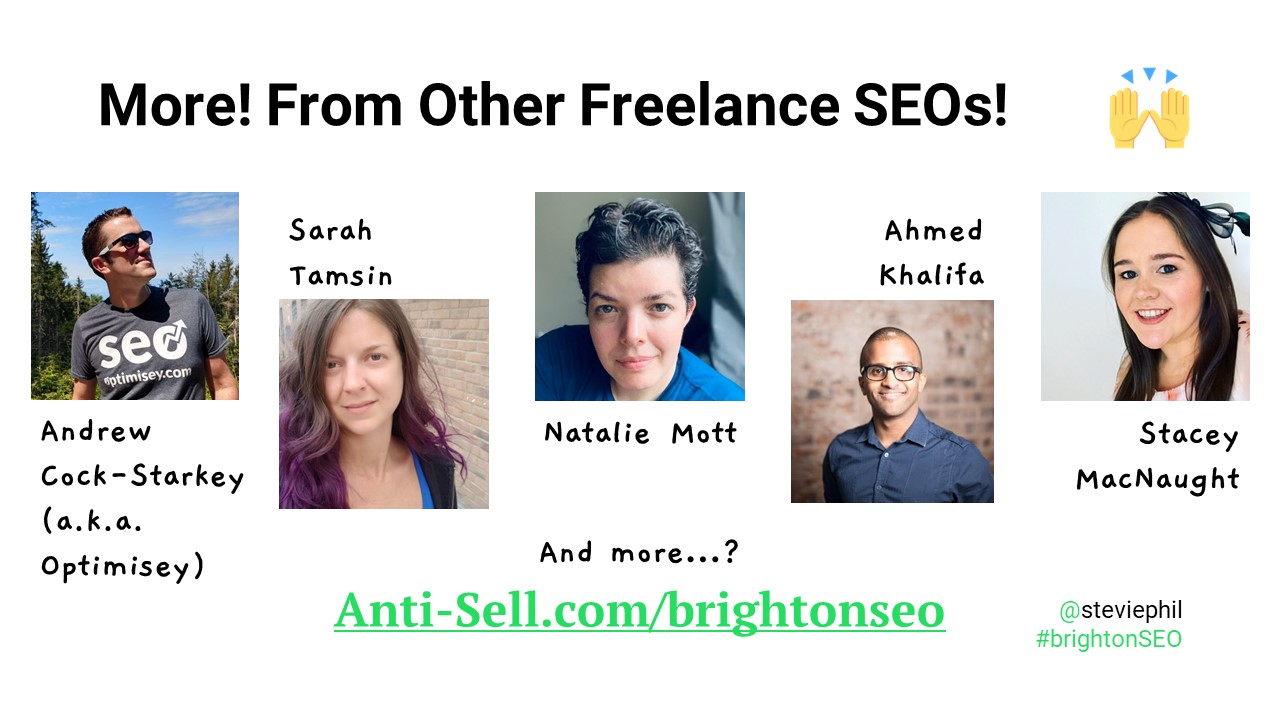
A big thank you to all these freelancers for contributing. So the original plan was that I was going to include like snippets of their tips within the talk, but I ran out of time. So what I’ve done instead is if you go to anti-sell.com/brightonseo, you will find a page that has all of their contribution. Consider it as like a complimentary supplement to this talk, where people like Andrew, Sarah, Natalie, Ahmed, Stacy and a few others potentially – as I record this it’s just those five, but there’s a few more – give their advice on how to be an SEO freelancer.
Slide 18 – Blog Post
I’ve written a blog post: 15 ways to get SEO clients. Go to anti-sell.com/seo.
Slide 19 – Anti-Sell
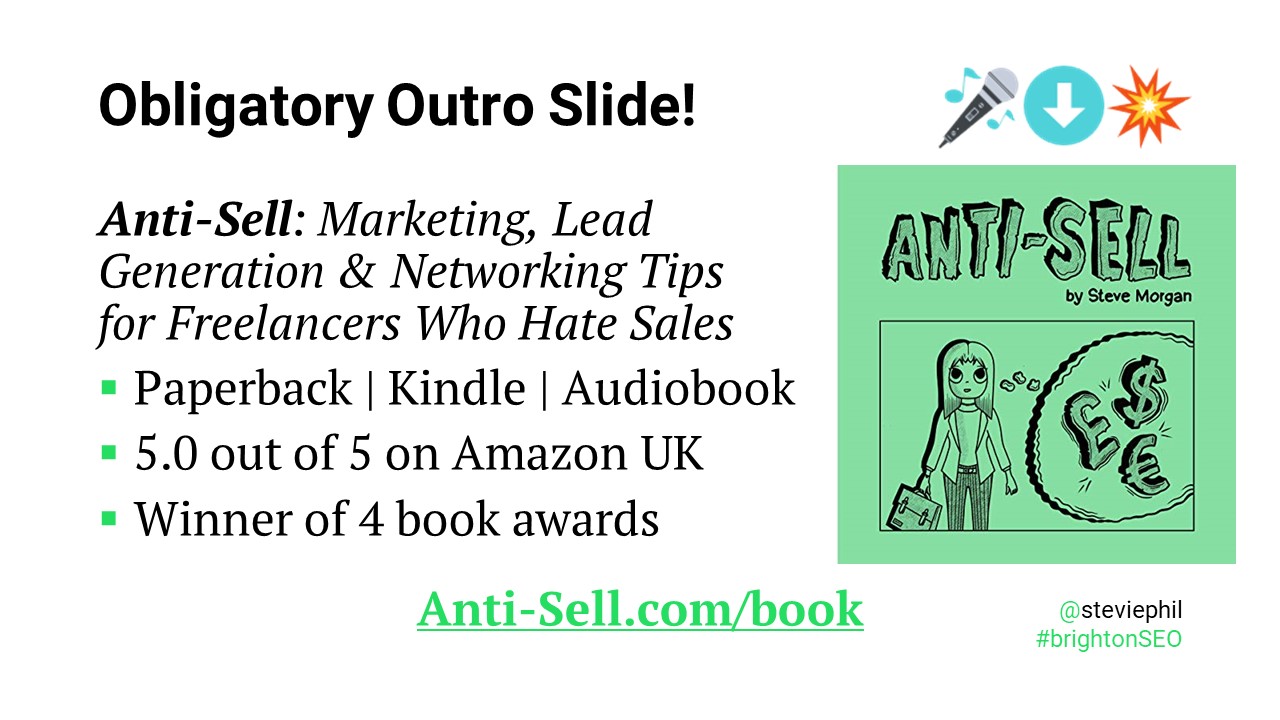
And I wrote a book. It’s called Anti-Sell. It gives marketing, lead generation and networking tips for freelancers who hate sales. It’s available in paperback, Kindle, audiobook. And people seem to like it. It’s got an average of 5.0 out of 5 on Amazon UK from about 40/50 reviews, and it’s won four book awards as well which I’m really chuffed and proud about. anti-sell.com/book.
And according to my stopwatch, I have about five seconds left, so I’ll just wave really awkwardly! Thank you very much!
Liam Power
June 27, 2025 at 4:30 amJust stumbled across the post in 2025. I’ve been a freelancer for 20 years, great advice!
Steve
June 27, 2025 at 8:25 amThanks Liam! 😃