
Over the past few years, SEO and PR have become more and more entwined. Links from good, high quality websites are important for SEO, and PR can really help to get those links, especially in the form of press mentions. I often say to clients that they should treat the likes of the BBC and the Guardian as the ‘holy grail’ of link building – getting links from sites like those can be like SEO gold-dust.
While SEOs have become more PR-savvy, we haven’t necessarily seen the same thing with PRs becoming more SEO-savvy. When I worked for Confused.com way back in 2010, I worked with some great colleagues in the PR team who truly ‘got’ SEO (shout-out to @KellysDavies and @PRVix!), and I was excited to see how other PR folk would progress in a similar way over the years – but to be honest, I’ve personally not seen as much movement as I’d hoped or expected… Econsultancy have written a few articles about the phenomenon over the years, who – even as recently as a year ago – are still seeing the same thing.
So if I were to give one bit of crucial advice to PRs who want to help their clients’ SEO with their PR efforts, it is this: when coming up with a campaign, try to create something that people (and the press) have no choice but to link to.

Now I know what you’re thinking… “But that’s obvious!”
…Not necessarily though. I’ve seen some PR campaigns that do not seem to keep this in consideration, as I will explain in more detail (while providing an example to the contrary) below…
The notoriousness of the press
The problem with press websites is that some of the major press websites are notorious for avoiding linking out if they can help it. I worked at Confused.com – whose name is a URL itself, for goodness sake – and they still wouldn’t get linked. Here are some recent examples. And while some speculate that brand name ‘citations’ (i.e. non-hyperlinking mentions) may still hold some SEO weight, it can’t be that much – and even so, for businesses that have a commonly-used name (e.g. “Horizon Solutions”), it may be difficult for Google to ascertain whether the citation refers to the Horizon Solutions in the UK, the Horizon Solutions in the US, or the Horizon Solutions in Canada, for example…
That said, the BBC started adding links in articles a few years ago. I hoped that others would follow the trend, but it’s still a rarity in my experience. Some say it’s because newspaper websites don’t want you straying off, getting distracted and leaving their site (as that’d mean less ad impressions/clicks).
The exception to the rule is when they are talking about something that makes 100% logical sense to link to – or where they’d look really silly if they didn’t.
In fact, when I worked at Confused.com, I conducted a full inbound link analysis of the site at the time, which I was then able to break down further by PR-generated links, followed by which particular PR campaign sparked those links. We found that one PR campaign generated a lot more links than some of the others – and it was because there was an added ‘link-worthy’ element to it.
…Annoyingly, no thanks to my terrible memory (bearing in mind that I worked there 4 years ago, and I can barely remember what happened last week…!), I can’t remember the campaign in question. Fortunately, with a hat tip to @wayneb77, I can share a different example instead…
Paying for parking with conkers
Over a year go, Town Centre Car Parks released the news that for one week in September 2013, you could park in certain car parks in Leeds and Manchester for free… by paying using conkers. The link now redirects, but if you look at it using Open Site Explorer, it has 6 links from 6 domains. Not massive numbers, admittedly (although more than a lot of other PR campaigns, I reckon), but what’s interesting is how and why one of the sites has linked to it:
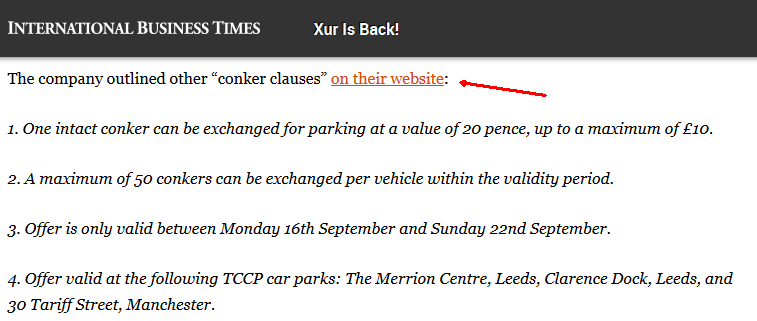
Even though they’ve copied and pasted the conkers scheme’s terms & conditions within their post, they’ve still linked to the website. It’s like they’re saying: “find out more about it here.” Rather than simply talking about it and that’s it, they’re talking about it and linking to the site’s dedicated page for it.
And that’s the trick… Can you come up with a PR campaign that encourages linking? If your PR campaign’s centrepiece is a YouTube video for example, then there’s the risk that news sites will simply embed it on their own sites and still not link to you. But what if it’s something like a quiz, or a competition, or a game, or a full-on resource containing lots of videos (too many to embed)? It’d be a bit silly if they talked about something like that and didn’t link across, right? What’d be the point of them talking about it in the first place?
So if you work in PR, you have an interest in SEO, you’re reading this and you think you can pull it off for your own clients, then you will increase your worth and value to your clients and be ahead of the game in your industry.
…So what are you waiting for? 😉
I’m actually working on something special that I’m launching next month called CR 25, which I’m hoping will put this rule into practice. Well… that’s the plan anyway! I guess we’ll have to see…
[PR image credit – Niuton May]
Kumail Hemani
December 9, 2014 at 7:11 amGood luck with your “CR 25” plan, Steve! 🙂
Steve
December 9, 2014 at 7:17 amThanks Kumail! 🙂